
Custom Flash systems design
Specializing in the design and customization of high-performance Pulsed Xenon Flash Systems and Driver Modules, our Development team delivers solutions tailored to precise application requirements
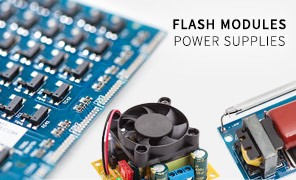
All functional features can be integrated into compact, state-of-the-art flash driver modules, ensuring optimal performance and reliability.
Customization is available at multiple levels, including the main PCB, auxiliary daughter boards, enclosures, and power supply units, allowing full system adaptation to specific operational and environmental conditions.
Our Key Design Expertise Areas
- Machine Vision & Imaging: Providing ultrashort light pulses to freeze rapid motion, supporting high-precision automation and robotic inspection systems
- High-Speed Video lighting: Long pulse duration Flash systems for illuminating high-framerate video capture in scientific experiments
- BioMetric cameras & Document security Specialized lighting for security imaging and authentication devices
- PhotoBooth Lighting professional flash solutions for photography studios and photo booths
- Stroboscopes, Timing lights Precision-timed pulsed light for measurement and inspection applications
- Lighting effects & Shows Custom flash effects for exhibitions, live shows, and special events
Prototyping steps
For early prototypes or proof-of-concept stages, we can typically provide a modified stock system or module manually adapted to your unique project requirements, enabling ultra-fast turnaround—often within 1–2 days. This approach offers a low-cost, rapid initial prototype that can be delivered in just a few days.
Following testing and verification, a fully customized PCB can be designed, integrating the selected features and capabilities of the flash driver, while ensuring seamless interface compatibility with your existing product environment.
Flash Module board properties
Key Parameters for Flash System Design
- Flash system application: Specify the intended use- Photography, Warning Light, IPL, Laser, Stage Lighting, etc.
- Input voltage: Indicate the available power source(s) for the system.
- Per-Flash Energy: Define the required brightness or energy output per flash.
- Flash Frequency: Specify how often the lamp will be fired. (Is there a specific pulse train or sequence requirement?)
- Trigger method: Choose between auto-repeating strobe or external input for the trigger signal.
- Variable Energy/duration: Indicate whether adjustable flash energy/duration is needed or a fixed setting suffices.